Your suitcase is bulging, yet you’re still worried you’ll freeze at the destination. Maybe you searched winter travel packing list tips at 2 a.m.—been there. There’s a smarter way to pack for the cold.
Most people overpack bulky coats, miss the right layers, and end up cold or soaked. The cost stacks up: checked bag fees, last‑minute gear, and lost time hunting for warm socks. I’ve learned the hard way after a slushy week in Oslo.
By the end, you’ll have a lean carry‑on plan for seven days, dialed layers for dry, wet, and mountain cold, and fabric rules that work. I’ll show you how to balance warmth with weight—plus what to skip. Expect clear checklists, smart swaps, and winter travel packing list tips you can use tonight. First up: building layers that beat any forecast.
Build A Layering System For Dry, Wet And Mountain Cold
Cold isn’t one thing—it’s three. Dry cold bites with low humidity, wet cold soaks and chills to the bone, and mountain cold adds wind and altitude.
Here’s the thing: a smart system beats a bulky coat. Build three layers—base for moisture management, mid for insulation, shell for wind and water—and swap pieces to match the day.
💡 Pro Tip: Wind turns “fine” into frostbite risk fast. The National Weather Service wind chill chart shows how a 20°F day feels like 4°F with 25 mph gusts—pack a shell even on clear days.
Picture this scenario: you land in Reykjavík, walk 15 minutes, and suddenly a sleet burst hits. With a merino base, light fleece, and waterproof shell, you’re warm and dry. No panic purchase. No soaked cotton.
Worried you’ll sweat then freeze? Regulate with zips and fabric weights, not with one mega parka. Time: 10 minutes. Prerequisites: forecast, planned activity, and access to your gear.
| Climate | Key Layers | Notes |
|---|---|---|
| Dry Cold | Merino base + fleece mid + windproof softshell | Prioritize breathability; add hat and neck gaiter |
| Wet Cold | Synthetic base + fleece or active-insulation + waterproof shell (taped seams) | DWR-treated shell; avoid down in steady rain |
| Mountain Cold | Merino base + lofty down/synthetic puffy + hardshell (Gore‑Tex or similar) | Windproof hood; bring liner gloves for dexterity |
What You’ll Lay Out
- Merino or synthetic base top and bottom
- Light or midweight fleece (grid or classic)
- Down or synthetic insulated jacket
- Waterproof, breathable shell with hood
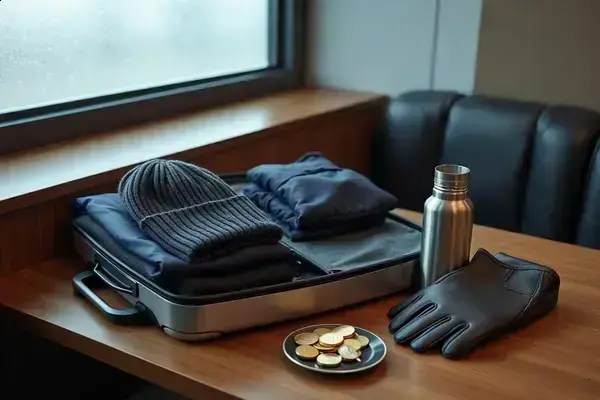
- Warm hat, gloves, and neck gaiter
- Thermal socks (merino blend)
Quick Build Steps
- Check hourly forecast and wind speeds for your route.
- Choose base weight: lightweight for active days, midweight for low-output.
- Add midlayer: fleece for breathability; active insulation for stop‑and‑go.
- Pick shell: softshell for dry wind; hardshell for rain, sleet, or spindrift.
- Pack a compact puffy to deploy during rests and evenings.
- Test indoors: move, unzip, and adjust so you don’t overheat.
If you have circulation or respiratory conditions, consult a healthcare professional for personalized cold‑weather advice before traveling.
And this is exactly where most people make the most common mistake—confusing warmth with bulk instead of choosing the right fabrics and zips.
Pack Light Vs Pack Warm: What Actually Matters
Packing light and staying warm feel like opposites. Airlines squeeze you; winter tempts bulky layers that hog space and spike baggage fees.
Here’s the thing: warmth comes from trapped air, not raw weight. So what actually matters—grams on a scale or thermal efficiency that holds up outdoors?
| Approach | What To Pack | Tradeoffs |
|---|---|---|
| Pack Light | 800‑fill down puffy, 1–2 merino bases, ultralight shell, fleece hat and gloves | Great warmth‑to‑weight, but needs smart layering in damp cold |
| Pack Warm | Thick wool coat, heavy sweater, lined pants | Cozy in short bursts; bulky, slow to dry, hard to carry on |
| Smart Hybrid | Merino base x2, active‑insulation mid, 3‑layer waterproof shell, packable puffy | Most versatile; slightly higher cost, highest flexibility across conditions |
Worth noting: down’s “fill power” (700–900) measures loft per ounce—higher means warmer for the weight. Synthetic “CLO” ratings do the same for non‑down insulation. And a 20k/20k waterproof‑breathable shell handles storms without becoming a sauna.
💡 Pro Tip: Wear your bulkiest layer and boots on the plane, but don’t crush down for days—store it loosely. According to IATA, many airlines cap carry‑on bags around 7–10 kg, so shift weight to what you wear.
In practice: picture this scenario—Mia’s weekend in Munich shows sun, sleet, and evening markets. She skips the heavy peacoat, packs a 9 oz 800‑fill puffy, two merino tees, a light grid fleece, and a 3‑layer shell. Carry‑on only, zero shivers.
Decide In 6 Quick Steps
- Check the real feel: temperature range, wind, and precipitation windows.
- Match activity: city strolling vs. hikes (more movement = lighter midlayer).
- Pick insulation: 700+ fill down under 14 oz, or a 60–80 g synthetic jacket for wet plans.
- Choose shell: 3‑layer waterproof for rain/sleet; softshell for dry wind days.
- Limit bases: two merino tops, one thermal bottom, rotate daily.
- Control bulk: one puffy, one mid, two hats/gloves total; use compression cubes for socks—not for down.
According to REI Co‑op Expert Advice, down offers the best warmth‑to‑weight, while synthetics keep insulating when damp—use both strategically.
What actually works might surprise you—your heaviest savings often hide in footwear and socks…
Fabrics To Choose And Avoid For Real Winter Performance
Warmth isn’t magic—it’s fabric doing work. The wrong fiber traps sweat, chills you, and smells by noon. The right one keeps heat in and moisture out.
Here’s the thing: focus on fiber (merino, polyester, nylon), structure (knit vs. weave), and treatments (DWR, membranes). Those three choices decide comfort more than any logo—especially in wet or windy cold.
💡 Pro Tip: Skip cotton next to skin. The National Park Service echoes the old rule “cotton kills” because it soaks, cools fast, and dries painfully slow in winter.
In practice: picture this scenario—you spill coffee on your tee in Prague, 28°F with wind. A merino base stays warm while damp and won’t smell later. A cotton tee? It clings, chills you, and forces an early return to the hotel.
| Fabric | Best Use | Watch‑Outs |
|---|---|---|
| Merino Wool (150–250 GSM) | Base/mid for odor control and warmth when damp | Dries slower than synthetics; can snag; costlier |
| Polyester/Nylon Wicking Knit | High‑output base layer; fast dry | Can smell sooner; choose anti‑odor blends |
| Fleece (Polyester) | Breathable midlayer; great for dry cold | Wind passes through; add shell in gusts |
| Down (700–900 fill) | Maximum warmth‑to‑weight in dry, frigid air | Loses loft when soaked; use shell or hydrophobic down |
| Synthetic Insulation (60–100 g) | Wet‑cold and stop‑start activity | Heavier for same warmth vs. down |
| Hardshell (ePTFE/PU membrane) | Rain, sleet, strong wind; travel storms | Low breathability feels clammy; check RET rating |
| Cotton/Denim | Evening wear only, indoors | Holds moisture; long dry times; chills fast |
Worth noting: ISO 11092 uses the RET scale for breathability—under 6 is very breathable, 6–13 is breathable for active travel. AATCC 22 spray ratings help you gauge durable water repellent performance after rain.
Smart Picks At A Glance
- Choose: merino base (150–200 GSM), grid fleece mid, 3‑layer waterproof shell, 60–80 g synthetic puffy for wet trips.
- Avoid: cotton socks, heavy acrylic sweaters, untreated canvas—great street style, poor thermal performance.
- Mix: nylon outer with DWR for abrasion plus a soft wicking lining for comfort against skin.
And honestly? Most cold‑weather misery starts with a damp base layer—fix that first, then optimize the rest.
But there’s one detail travelers overlook until it’s too late—how to turn these fabric choices into a tight seven‑day packing blueprint without checking a bag…
The 7-Day Carry-On Packing List: Space-Saving Blueprint
Seven days, one carry‑on—possible without freezing? Yes. You’ll trade duplicates for smart layers and a tiny laundry plan that saves space and fees.
The truth is: a capsule kit works. You’ll rotate pieces, air‑dry at night, and rely on warmth‑to‑weight fabrics rather than bulky backups.
- Tops: 2 merino base tees (150–200 GSM), 1 lightweight sweater, 1 grid fleece.
- Insulation: 1 packable down or 60–80 g synthetic jacket.
- Shell: 1 waterproof, breathable hooded jacket.
- Bottoms: 1 travel pant, 1 softshell or lined pant, 1 thermal tight.
- Underlayers: 4 underwear, 4 merino socks, 1 sleep set.
- Footwear: Waterproof boots (wear), low‑profile sneaker (pack, optional).
- Accessories: beanie, neck gaiter, liner + insulated gloves, sunglasses.
- Toiletries: solids where possible, 1 quart bag for liquids, minimal makeup.
- Laundry mini‑kit: detergent sheets, sink stopper, travel clothesline.
- Tech & admin: universal adapter, power bank, eSIM/roaming plan, copies of IDs.
💡 Pro Tip: Keep liquids to TSA’s 3‑1‑1 rule—3.4 oz containers in 1 clear quart bag, 1 bag per traveler. It’s the fastest way through security with winter gear.
In practice: Jamie flew to Sapporo with one 35 L bag. She wore boots and shell, packed the puffy, rotated two base tees, and hand‑washed socks on night three. Result—warm days, light bag, zero baggage fees.
Pack It In This Order
- Place boots by the wheel well; stuff with socks and the clothesline.
- Lay packing cubes: underwear/socks (small), bases (medium), mids (medium).
- Roll pants on the spine; wedge between cubes to prevent shifting.
- Compress the puffy lightly; never vacuum it—preserve loft.
- Fold the shell flat on top for quick access at the gate.
- Slip the quart liquids bag and power bank in the outer pocket.
Worth noting: a digital luggage scale helps you respect strict 7–10 kg carry‑on caps—cheaper than paying oversize at the counter.
And this is exactly where most people make the most common mistake—underestimating how socks and footwear care dictate warmth and pack weight…
Footwear, Accessories And Care: Warm Feet, Dry Gear, Fresh Clothes
Cold feet end trips early. Yours don’t have to. The real trick is pairing the right boots, smart accessories, and simple care—so warmth lasts all day without extra weight.
Start with boots that balance protection and comfort. A waterproof membrane plus winter rubber keeps slush out and traction steady on slick stone. Look for a roomy toe box to maintain circulation, medium flex for walking comfort, and lugs around 4–5 mm for grip. The American Podiatric Medical Association notes that stable support and adequate toe space reduce hotspots and numbness when temperatures drop.
Socks do more work than jackets. Choose merino‑rich blends with nylon reinforcement; they insulate even when damp and dry overnight. A thin liner sock cuts friction on longer days, while a cushioned hiking sock adds warmth for static moments. The Centers for Disease Control and Prevention flags wet, tight socks as a frostbite risk—space and dryness matter more than sheer thickness.
💡 Pro Tip: Dry boots from the inside out—remove insoles, crack the laces wide, and stuff with microfiber cloths or dry paper. Avoid direct heaters, which can delaminate soles and damage membranes.
Accessories seal the system. A snug beanie and neck gaiter prevent heat loss at low windchill, while a glove “stack” (liner + insulated glove or mitten + weatherproof shell) lets you adjust fast. Don’t skip eye protection—snow glare is real, and the World Health Organization notes snow can reflect much of UV radiation, which strains eyes on bright winter days.
Care is where most travelers win. After each outing, brush off salt, wipe seams, and re‑activate DWR on leather or fabric with a quick, cool tumble or a travel‑safe spray. Pull insoles nightly and air them near gentle airflow; drop a couple of silica gel packets inside boots to cut overnight moisture. For clothes, rinse socks and base layers with a small dose of enzyme detergent, then roll in a towel to pre‑dry before hanging—odor control without hotel laundry prices.
In practice: picture this scenario—Quebec sidewalks, late slush, one misstep into a curb puddle. You swap to a dry merino pair from a compact pouch, add short gaiters, open the boots at the hotel, and they’re dry by morning. The right habits in place now make everything easier from here.
Warm, Light, And Ready
You’ve got the essentials: a flexible layering system for dry, wet, and mountain cold; fabrics that stay warm when damp; and a 7‑day carry‑on plan that actually fits. If you take just one thing from this guide, let it be: modular layers beat bulk every time. These winter travel packing list tips turn stress into a simple routine.
Before, packing felt like guesswork and heavy fees. Too many sweaters, still cold toes, and a suitcase that wouldn’t close. Now you can travel lean, stay warm, and keep gear dry with small daily habits. Less weight. More comfort. Real confidence.
Which upgrade are you trying first—swapping cotton for merino, building a liner‑mid‑shell stack, or reworking your 7‑day kit? Tell us in the comments!

Ava Marie Caldwell is a passionate traveler, travel planning writer, and the founder of this blog — built for people who want to travel more, stress less, and actually enjoy the planning process.
After years of figuring things out the hard way — overpacking for every trip, booking the wrong accommodation, missing cheap flight windows by days, and once arriving at an airport without a printed visa — Ava decided to document everything she learned and put it in one place.
This isn’t a luxury travel blog with sponsored resort stays. Ava is not a certified travel agent or tourism professional — just someone who has taken the trips, made the mistakes, and found the systems that actually work for real travelers with real budgets and real lives.
Every article on this site is researched with care, written from genuine experience, and designed to save you time, money, and the kind of stress that ruins the first day of a trip you’ve been planning for months.
Whether you’re packing for your first international flight, planning a road trip with the family, or finally doing that solo trip you’ve been putting off — this blog was built for you.
When she’s not writing or planning her next trip, Ava is testing new packing systems, comparing flight booking tools, and trying to convince everyone that a carry-on is always enough.